

CG Policy · 2025
In this section7 topics
Corporate Governance Policy
Has a Corporate Governance Policy
Yes
Policy Description
The Board of Directors is committed to developing the organization into a transparent and accountable organization, with a responsibility to maintain and uphold the benefits of stakeholders and society. They aim to develop personnel who are ethical and moral, while promoting the development of information technology education to enhance the sustainable growth of the organization. They also aim to contribute to the development of the society and the country.
The sustainable development practices are described below:
Overseeing business operations with integrity
Anti-corruption
Respecting human rights and taking social responsibility
Participating in community development by improving the quality of education
The Risk Management, Corporate Governance and Sustainability Committee communicated to directors, executives, and employees to acknowledge and realize the importance of good corporate governance. In addition, the Company’s Corporate Governance manual is used as the guideline to consider risky behavior which may come against the ethics and work guidelines, helping to promote the organization’s corporate governance, improving the company’s business operations and encourage the organization’s people to have moral mind. This move will gain confidence and acceptance from the society and lead to a sustainable growth through the internal channels and MFEC’s website ir.mfec.co.th
Policy Document Link
https://ir.mfec.co.th/en/corporate-governance-policy/
Policy & Practices — Board of Directors
Has Policy & Guidelines for the Board
Yes
Board Guidelines
| Guideline | Other — Please Specify | Detail |
|---|---|---|
| Nomination of Directors | Guidelines for the Nomination and Selection of Qualified Individuals for the Position of Director/Independent Director In 2025, the Nomination and Remuneration Committee was responsible for selecting individuals to serve as directors and independent directors with diverse qualifications and experience. These include skills, expertise, and abilities that would benefit the Company, as well as a commitment to dedicating time and effort to performing their duties. The goal is to strengthen the Company’s board of directors. The committee has set a guideline that a director should serve on the board of no more than five listed companies. The Company provides an opportunity for minority shareholders to propose qualified candidates for the position of director. These proposed individuals are presented to the Nomination and Remuneration Committee, which will then forward the recommendations to the Board of Directors for consideration, and subsequently to the Annual General Meeting of Shareholders for approval and appointment, in accordance with the Company’s Articles of Association. This requires approval by a majority vote of shareholders present and entitled to vote, with each shareholder having one vote per share. Each shareholder must use all of their votes to elect one or more candidates as directors. The candidates with the highest number of votes, in descending order, will be elected as directors in the required number. In every Annual General Meeting, one-third of the directors must retire from their positions in a rotation process. For non-independent directors, the number of directors may be determined in proportion to the shareholding in the Company, depending on the suitability and capabilities of the candidates selected. | |
| Determination of Director Remuneration | Guidelines for Determining Board of Directors and Subcommittee Compensation
| |
| Independence of the Board of Directors from the Management | The Chairman of the Board, Mr. Sirisak Tirawattanangkul, is not an independent director and is not the same individual as the Chief Executive Officer (CEO). Additionally, there are no familial or business relationships between the Chairman and the CEO. MFEC has established a clear separation of roles and responsibilities between the Chairman of the Board and the CEO, as outlined in the company's corporate governance policy. MFEC also ensures a clear division of roles between the Board of Directors and the management team. The Board retains decision-making authority over matters of significant business impact. However, the Board encourages a strong, collaborative relationship between directors and management by fostering a corporate culture that emphasizes mutual respect for each party’s role and governance principles. The Chairman is responsible for overseeing and ensuring that the Board operates effectively and achieves the organization’s key objectives and strategic goals. Key responsibilities include: Setting the Board meeting agenda in consultation with all directors. Ensuring key issues are included in the meeting agenda and that adequate time is allocated for management to present matters and for directors to thoroughly discuss and deliberate on important topics. Encouraging directors to exercise independent judgment and express their opinions freely. Fostering a positive relationship between executive and non-executive directors. Promoting collaboration between the Board and management to uphold good corporate governance. | |
| Director Development | Development and Enhancement of Skills and Knowledge for Directors, Executives, and Employees
| |
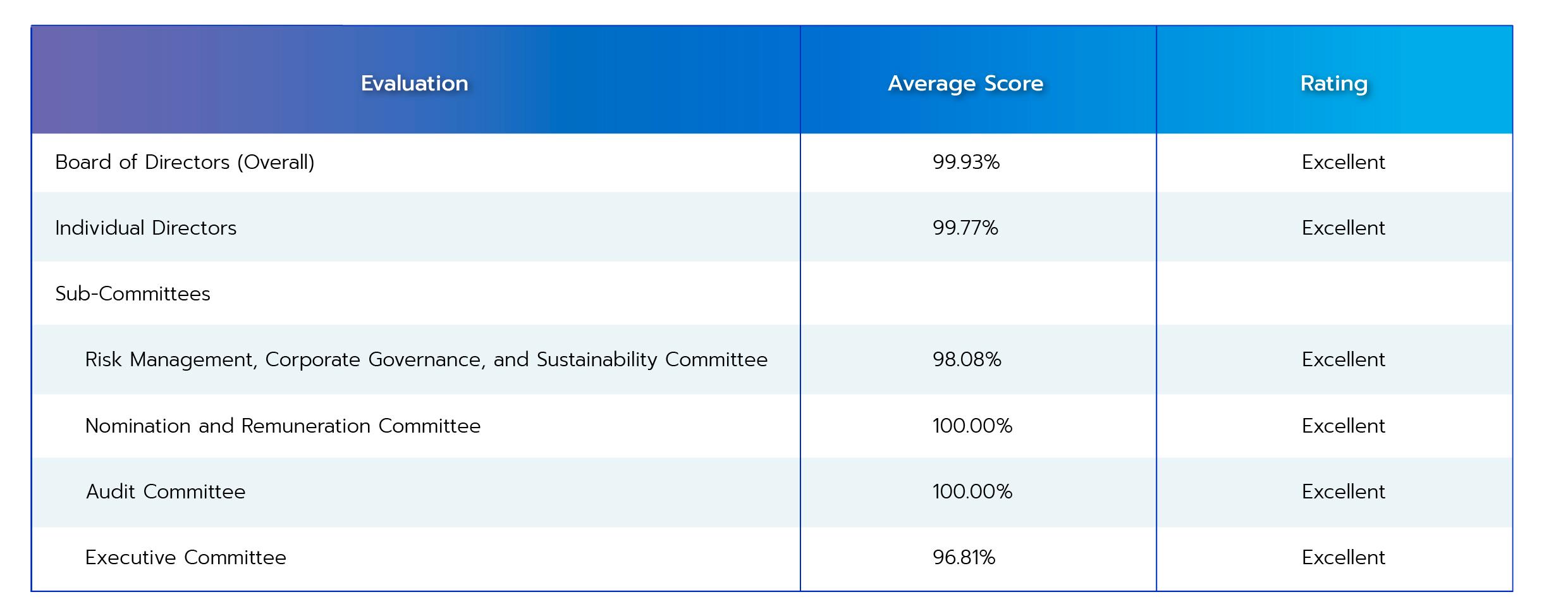
| Board Performance Evaluation | The Company has established a policy requiring the Board of Directors to conduct a self-assessment at least once per year in order to review performance, key issues, and challenges encountered during the past year, as well as to enhance the effectiveness of the Board in accordance with the principles of good corporate governance. The Company Secretary is responsible for distributing the annual performance evaluation forms, which are prepared in accordance with the guidelines of the Stock Exchange of Thailand (SET), to all directors. After the directors complete the evaluation, the Company Secretary compiles and summarizes the results and presents them to the Nomination and Remuneration Committee, as well as to the Board of Directors, for consideration and for use as information in further improvement and development. The evaluation process is conducted to cover the overall performance of the Board of Directors, the performance of Board subcommittees, and the individual performance of each director, with the details as follows:
The results of the Board of Directors’ performance evaluation for the year 2025 can be summarized as follows:
| |
| Corporate Governance of Subsidiaries and Associated Companies | Governance of Policies and Operations of Subsidiaries and Invested Entities According to the company’s policy, which promotes and co-invests with employees who possess knowledge, expertise, and management potential, the company has established new subsidiaries. Additionally, the company has a policy to co-invest with business partners to expand its service offerings comprehensively. (Details of subsidiaries and other invested entities are presented in Section 1.3: Shareholding Structure of the Group.) In this regard, the Board of Directors has established a framework and mechanisms to oversee the invested companies as follows:
Scope of Authority and Responsibilities of Directors/Representatives The authority and responsibilities of directors and representatives are as follows:
This governance mechanism is implemented through the appointment of representatives, directors, or executives who have been approved by the Board of Directors to serve as directors in subsidiaries and affiliated companies. Additionally, the company has an internal audit function to assist in verifying and reviewing the internal control systems of subsidiaries and affiliated companies. This ensures that management practices are conducted in a structured, sufficient, and appropriate manner, with findings reported to the Audit Committee for acknowledgment. | |
| Other guidelines regarding the board of directors | Practices for Strengthening an Effective Board of Directors | The Board of Directors recognizes its roles, duties, and responsibilities in guiding the Company toward its defined objectives and strategic goals. The Board plays a crucial role as a key driving force in ensuring the Company’s sustainable growth. Accordingly, the Company has established a clear board structure, qualifications, criteria, and processes for the nomination, selection, and appointment of individuals to serve as directors when terms expire, when vacancies arise, or when additional appointments are required. The Nomination and Remuneration Committee is responsible for identifying and proposing qualified candidates by considering their knowledge, capabilities, expertise, and professional experience. Candidates are also evaluated based on their proven work records, broad vision, integrity, and ethical standards, as well as their ability to devote sufficient time and attention to perform their duties responsibly for the benefit of the Company’s operations. In addition, the Company considers Board Diversity when determining the composition of the Board. A Board Skill Matrix is prepared to identify the overall qualifications and competencies required of directors. This framework helps determine the desired attributes for new directors by considering the skills that may still be lacking, as well as qualifications that align with the Board’s structure and the Company’s strategic business direction. The nomination process does not discriminate based on gender, sexual orientation, age, race, nationality, religion, or other differences. As a result, the Board of Directors possesses qualifications that are appropriate and aligned with the Company’s business strategy, while also reflecting diversity in knowledge, capabilities, skills, experience, and expertise that contribute positively to the Company’s operations. The composition of the Board of Directors reflects diversity in terms of professional experience, educational background, gender, sexual orientation, race, nationality, and place of origin. The Board includes independent directors representing more than one-third of the total number of directors, and non-executive directors representing more than half of the Board, ensuring that decisions can be made independently on behalf of all shareholders and providing appropriate checks and balances in the management structure. The Company has established clear responsibilities regarding directors’ duties and time commitments, along with mechanisms that support directors in understanding their roles and responsibilities. In addition, the Company has set guidelines regarding directors’ positions in other companies to ensure that they can devote sufficient time to perform their duties effectively. Each director should not hold directorships in more than five listed companies in total. A reporting system has been established for directors to disclose their other directorships and any conflicts of interest, whether direct or indirect, in other businesses. Relevant criteria and information are disclosed to ensure transparency. Furthermore, each director is required to attend at least 80 percent of the total number of Board meetings. |
Code of Conduct
Has a Business Code of Conduct
Yes
Code of Conduct Description
The company's business practices are founded on its core values, providing a shared framework for all employees to follow as a guideline for appropriate conduct. These practices are integrated into the company’s work regulations at all levels, from operational staff, business unit heads, executives, directors, independent directors, the Chief Operating Officer, the Chief Executive Officer, and the Chairman of the Board. Everyone within the organization is responsible for adhering to the principles and best practices outlined in the Code of Conduct.
All employees are expected to study and understand the company’s ethical guidelines relevant to their roles and responsibilities. Regular discussions between employees and their supervisors ensure that actions taken align with ethical standards. Additionally, communication with relevant stakeholders is essential to ensure a clear understanding of the company’s ethical principles. If any unethical conduct is observed, employees are encouraged to report such incidents through the designated whistleblowing channels.
Code of Conduct Link
https://ir.mfec.co.th/en/code-of-conduct/
Code of Conduct Practices
| Guideline | Detail | Document Link | Page Number in Report |
|---|---|---|---|
| Prevention of Misuse of Inside Information | Principle The Company acknowledges that business operations may cause conflicts of interest in various forms. Therefore, the Company has established a policy and guidelines to ensure that business operations of the Company are conducted with integrity and transparency according to Good Governance Policy. Company and shareholders’ best interest must be taken into account and any behaviors that may cause conflicts of interest must be avoided. Definition Conflict of Interests Conflict of Interest means a duty undertaken to provide gain or outcome which satisfies the company’s objective, but bring benefit to oneself or other related persons. As a result, the company does not fully reap the benefit or may even suffer damages with problems. This is called a conflict of interest. Guideline
| https://ir.mfec.co.th/en/code-of-conduct/ | 22-23 |
| Anti-corruption | Principle The Company places a great importance on anti-fraud and anti-corruption whereby employees at all levels shall refrain from requesting, performing, or accepting all forms of corruption for any kind of benefit of the Company, themself, or business-related parties including business units in other country and related agencies. In this regard, the Company has arranged this policy and guidelines on anti-fraud and anti-corruption in compliance with rules, regulations, and legal requirements for employees at all levels to adhere with their duty performance. Definitions Corruption Any forms or activities of bribery whether offering, promising, providing, pledging, demanding, or accepting money, assets, or any kind of benefits to government officials, government agencies, private entities, or persons in charge directly or indirectly. That forms or activities may influence or impose of those performing duties leading to acquire or retain business or business relationship to the Company in particularly, or to acquire or retain the impropriated business benefits. Exceptions are made providing that the law, rules, notification, regulation, tradition, or business practices allowed in doing so. Fraud Seeking any kind of unlawful benefits for themself or others or taking personal interests over benefits of the Company, e.g. misappropriation of the company's assets, fabrication of documents, abuse of entrusted power or misconduct of disbursements, etc. Guidelines
| https://ir.mfec.co.th/en/code-of-conduct/ | 13-14 |
| Whistleblowing and Protection of Whistleblowers | MFEC sets the system for whistleblowing or complaints. In the case that you know or witness any conduct or you are in a trouble involving corruption, non-compliance with laws, regulations, Articles of Association and Code of Conduct, you may provide information pertinent to such conduct in the following manners:
Remarks : The investigation must be carried out in confidence and with confidentiality, where the output of the investigation is kept confidential and complainants/whistleblowers are protected according to the Complainant and Whistleblower Protection Measures. | https://ir.mfec.co.th/รับข้อร้องเรียน/ | |
| Preventing the Misuse of Inside Information | Principle All directors, executives and employees shall not use inside information which is significant and not disclosed publicly for their own benefits and others’ gains. The directors, executives and employees have the rights and freedom to invest in MFEC securities and other listed companies. Guideline
Section 59 A director, executive, auditor of the securities issuing company shall have the duty to prepare and disclose reports to the SEC Office on each person holding securities and the holding of securities by his spouse and minor children in the following manners:
| https://ir.mfec.co.th/en/code-of-conduct/ | 34-35 |
| Prevention of money laundering | Principle The company will not receive a transfer of or transform assets or support a transfer of or transformation of assets involving a misconduct. The intention aims to prevent any person to use the company’s business channel to pass on, conceal or camouflage sources of illegal assets on whether or not it will bring the company or its stakeholders damages. Definition Money Laundering Money laundering is the process to conceal or disguise the true nature of acquisition, source, distribution, transfer and rights received. Guideline
| https://ir.mfec.co.th/en/code-of-conduct/ | 38-39 |
| Giving or receiving gifts, entertainment, or business entertainment | Principle The Company acknowledges that receiving or giving gifts, assets, or any other benefits including hospitality are the means that may lead to corruption. Therefore, the Company has established a policy and guidelines for receiving or giving gifts and hospitality to ensure that the operation is done in a transparent manner. Definition Giving and Receiving Gifts Giving or receiving gifts, assets, or any other benefits may lead to a risk of corruption or may lead to discomfort and affect decision making in the operations. This may cause the Company to lose some benefits in the end. Gifts may come in various forms, such as money, goods, services, gift certificates, etc. Hospitality Hospitality is the cost occurring from activities aiming for building good relations, and on some occasions are considered a social etiquette. This hospitality may include accommodations, travelling fares, costs arising from visiting some establishment, study visits, or food and beverage. Guideline
| https://ir.mfec.co.th/en/code-of-conduct/ | 15-17 |
| Compliance with laws, rules and regulations | Principle All directors, executives and employees shall perform themselves within the legal framework, regulations and Articles of Association and shall not witness, assist or do any action which violates the laws, regulations and Articles of Associations. Definition Regular Employee A person who is hired for a position and placed as a regular employee after a probationary period. Trainee An employee who is informed by the company as a trainee with a determined probationary period of either more or less than 120 days. Monthly Employee An employee which is agreeably hired by the company with a monthly wage rate and has the rights to earn wage for weekends, traditional holidays, vacation leave, sick leave, maternity leave, military service leave, ordination leave as set in the requirements. Contracted Employee An employee which is hired by the company with an employment contract clearly stating a start and an end of the employment. Guideline
| https://ir.mfec.co.th/en/code-of-conduct/ | 42-43 |
| Use and maintenance of data and assets | Principle The company has the regulations and guidelines on the company’s assets under the responsibility of employees or units in order to prevent loss, damage and defect of the assets as a result of misuse or insufficient caution. Definition Assets Tangible and intangible assets such as movable property, property, technology, academic knowledge, document of rights, patent, license as well as confidential information not disclosed publicly- business plan, financial forecast and human resource information. Technology Information System Tools and systems used for interpretation and transmission of electronics data such as computer, Internet, e-mail or programs. Guideline
| https://ir.mfec.co.th/en/code-of-conduct/ | 32-33 |
| Anti-competitive | Principle The company has realized the importance of trading legal focusing the business ethics, partner and customer’s benefits, including fair dealing in business. Hence, the company has established the antitrust and anticompetitive practices. Definition Trading Competition All business partners, dealers, suppliers, vendors, and any relevant business partners are able to price and/or quality of products or services without any conditions limited, whether direct or indirectly, so as to suspend, reduce, and restrict the service, production, distribution or delivering at lower market demanding. In addition, the trading competitor will not be intervened in business operation resulting in unfairly fixing price particularly in commodities and services corresponding to the demand of market. And consumers/users could choose and purchase products and services according to their own needs. Guidelines
| https://ir.mfec.co.th/en/code-of-conduct/ | 46-47 |
| Cyber security | Principles The Company recognizes the importance of data security and information systems. Therefore, the information technology policy is established for directors, executives and all employees to adhere and comply strictly. Definition Information Security To preserve the Company’s confidentiality, accurateness, availability of information security and information technology and communication system Information Technology System Equipment and systems in relation to proceed and transmit electronic data such as computers, network systems, the Internet, e-mail or programs. Computer System A computer device or set of devices that functioning by assigning commands, set of instructions, or else that enables the device or set of devices to automatically process and store data. Guidelines
| https://ir.mfec.co.th/en/code-of-conduct/ | 50-51 |
| Environmental management | MFEC Public Company Limited is committed to minimizing the negative environmental impact of its business operations and value chain. Additionally, the company aims to create a positive environmental impact through its business activities, products, services, and initiatives that promote a sustainable, eco-friendly economy for both its value chain and customers. In line with this commitment, MFEC actively supports the United Nations Sustainable Development Goals (UN SDGs) by fostering the development and adoption of environmentally friendly technologies, organizing initiatives that enhance environmental responsibility, and advocating for relevant sustainable practices. The company has developed an environmental policy that focuses on conservation, climate risk and opportunity management, and sustainable environmental stewardship. These efforts enable MFEC’s customers and business partners to operate sustainably while contributing to a greener future. | https://ir.mfec.co.th/en/corporate-governance-policy/#dflip-df_44828/1/ | |
| Human rights | Principle Violating the human rights is regard as severe impacts to the society. The company, as the civilian of the society, adheres to the principles of human rights following the international disciplines, treats to the stakeholders with fairness and equality, respects the rights of labor and human. Definition Human Rights the basic rights for all humans to receive equal protection without discrimination to make a distinction on the basis of physical or mental condition, race, nationality, religion, gender, sexual orientation, language, age, color, education and social status. Guideline
| https://ir.mfec.co.th/en/code-of-conduct/ | 30-31 |
| Occupational health and safety | Principle The company is aware of safety, occupational health, and environment in working place. Employees of all types of employment, contractors, suppliers, partners and third parties who work in the Company’s area or use the services of the Company, including external workplaces of the company Guidelines
| https://ir.mfec.co.th/en/code-of-conduct/ | 48-49 |
Promoting Compliance with the Code of Conduct
Promotes Compliance by Directors, Executives and Employees
Yes
Description
Promotion of Business Ethics Compliance for the Board of Directors, Executives, and Employees
The Company places great importance on fostering a corporate culture that upholds business ethics, ensuring that the Board of Directors, executives, and employees at all levels conduct their duties with transparency and integrity. In 2025, the Company implemented key measures to promote and assess employees' understanding of business ethics as follows:
Development of Business Ethics Knowledge
The Company has provided employees with learning opportunities regarding the Code of Conduct through mReady (Website Knowledge), an online learning platform. This enables employees to conveniently access relevant content and apply ethical principles in their daily work.
Assessment of Business Ethics Understanding
The Company conducted the "Code of Conduct Test 2025" via the mReady system to evaluate employees’ understanding of business ethics. This assessment also applies to new employees during their onboarding process. In 2025, employees participated in the test and successfully met the required standards. For those who did not pass, the Company will ensure they retake the test in the 2026 assessment cycle to reinforce their comprehension and adherence to the Code of Conduct.
These measures reflect the Company’s commitment to cultivating and promoting an ethical corporate culture with transparency in business operations. By doing so, the Company aims to enhance trust and confidence among shareholders, customers, and all stakeholders.
Anti-Corruption Networks & Projects
Joined or Declared Intent to Join Anti-Corruption Networks
Yes
Networks & Projects Joined
| Network / Project | CAC Certified |
|---|---|
| Thai Private Sector Collective Action Against Corruption: CAC | Y |
| United Nations Global Compact (UNGC) | |
| Participation of anti-Corruption networks and initiatives |
Material Changes & Developments in CG
Reviewed the CG Policy or Board Charter in the Past Year
Yes
Material Changes or Developments in the Past Year
Yes
Policy Review — Description
Key Corporate Governance Developments and Improvements in 2024
MFEC Public Company Limited places great importance on good corporate governance by continuously reviewing and enhancing its policies, practices, and governance systems. This ensures improved organizational management and alignment with the 2017 Corporate Governance Code for Listed Companies (CG Code) and international best practices. Over the past year, the company has implemented key improvements in the following areas:
Review of Corporate Governance Policies and Code of Conduct
The company has reviewed and updated its Corporate Governance Policy and Code of Conduct to ensure compliance with laws, regulations, and international best practices, while also incorporating ESG (Environmental, Social, and Governance) principles.
The company has enhanced its whistleblowing and complaint channels for both external stakeholders and employees to promote transparency and accountability.
Review of Board Charters and Subcommittee Charters
The Board of Directors conducts an annual review of the Board and subcommittee charters to ensure they remain up to date and aligned with the company’s management structure and corporate governance framework.
Strengthening Transparency and Ethical Business Practices
The Company demonstrates its commitment to being a transparent organization by implementing an Anti-Corruption Policy and guidelines related to the giving or receiving of gifts and hospitality (Gift and Hospitality).
The Company has renewed its membership in the Private Sector Collective Action Against Corruption (CAC) for the second time, reaffirming its commitment to conducting business with transparency and integrity.
The Company has advanced to the status of a CAC Change Agent, reflecting its strong commitment to ethical, transparent, and accountable business practices, as well as its continuous efforts to promote good governance across its supply chain and among business partners.
Enhancing Internal Control and Risk Management Systems
The company has updated its risk management framework and internal audit processes in accordance with the COSO standards and the guidelines of the Securities and Exchange Commission (SEC).
Digital technology has been incorporated to improve risk monitoring and management efficiency.
Communication and Engagement with Shareholders and Stakeholders
The company has enhanced communication channels to ensure that shareholders receive transparent, timely, and comprehensive information.
Shareholders are provided with opportunities to propose agenda items for the Annual General Meeting (AGM) and nominate candidates for the Board of Directors.
Implements the CG Code for Listed Companies
Yes
CG Code — Description
Compliance with Good Corporate Governance Principles
In 2025, the Risk Management, Corporate Governance, and Sustainability Committee reviewed the implementation of the Corporate Governance Code (CG Code) for Listed Companies (2017) issued by the Securities and Exchange Commission (SEC). The Company has adopted relevant principles in alignment with its business context. However, certain aspects remain unimplemented, with alternative measures planned for future consideration by the Risk Management, Corporate Governance, and Sustainability Committee, as outlined below:
The Chairman of the Board Should Be an Independent Director
Currently, the Chairman of the Board is a shareholder of the Company and plays a key role in managing the organization while ensuring the interests of the Company, shareholders, and all stakeholders are upheld.
Independent Directors Should Serve a Maximum Term of Nine Years
The Nomination and Remuneration Committee evaluates the qualifications, expertise, and specialized skills of each director, considering board diversity through a Board Skill Matrix as part of the nomination process. The proposed candidates are then presented to the Board of Directors and the Annual General Meeting (AGM) for approval. In 2025, three directors, including independent directors, Mr. Sirisak Tirawattanangkul, Mr. Kiyotaka Nakamura and Assoc. Prof. Dr. Kamales Suntivejkul completed their terms. Their nominations were reviewed by the Nomination and Remuneration Committee, endorsed by the Board of Directors, and disclosed to shareholders prior to the election process. The Board of Directors assessed and confirmed that these individuals possess the necessary qualifications, independence, and ability to provide unbiased opinions in accordance with applicable regulations. Their expertise and extensive experience continue to contribute valuable insights and recommendations for the Company's business operations.
Investor Relations
MFEC presents its operating performance, investment plans, and industry outlook to analysts and investors. In 2025, the Company communicated such information through the Annual General Meeting of Shareholders, quarterly participation in the Opportunity Day organized by the Stock Exchange of Thailand, and Analyst Meetings. These activities aim to provide investors and analysts with clear insights into the business direction and growth opportunities of the MFEC Group.
Internal Information Management
Beyond compliance with legal requirements, the Company upholds policies rooted in ethics, integrity, and transparency in its business operations with customers, partners, investors, and shareholders. The Company has established clear guidelines in its Code of Conduct, requiring directors, executives, and employees at all levels to adhere to and implement these principles. This ensures the protection of confidential and sensitive information, preventing unauthorized disclosure or access for improper purposes. Any violation of these policies is considered a serious offense and may result in disciplinary action.
The Company has established regulations regarding the use of undisclosed internal information to prevent such information from being used for personal or third-party benefit, as follows:
Confidentiality: Directors, executives, employees, and staff of the Company are required to strictly maintain the confidentiality of the Company’s internal and/or confidential information.
Prohibition of Disclosure and Personal Gain: Such individuals are prohibited from disclosing internal information or using such information for personal benefit or for the benefit of others, whether directly or indirectly, regardless of whether compensation is received.
Prohibition of Insider Trading: Directors, executives, employees, and staff, including their spouses and minor children, are prohibited from buying, selling, transferring, or receiving transfers of the Company’s securities, or entering into any related transactions using undisclosed internal information for personal or third-party benefit.
Blackout Period for Securities Trading: Directors, executives, accounting personnel, as well as their spouses and minor children, are prohibited from trading or transferring the Company’s securities during the period prior to the public disclosure of the Company’s financial statements and those of related entities.
Reporting of Securities Holdings: Directors and executives are required to prepare and report their securities holdings and any changes in such holdings including those of their spouses and minor children in accordance with Section 59 of the Securities and Exchange Act B.E. 2535 (1992) and the regulations of the Securities and Exchange Commission (SEC). A copy of such reports must be submitted to the Company on the same day the report is filed with the SEC.
Supporting Shareholder Participation and Communication
The Board of Directors ensures that shareholders actively participate in key company decisions. The Board oversees the smooth, transparent, and efficient conduct of shareholder meetings, ensuring shareholders can exercise their rights. Resolutions passed at meetings are disclosed, and meeting minutes are accurately and comprehensively recorded.
Shareholder Rights
The Company provides shareholders with opportunities to engage in corporate governance and share their opinions. In 2025, the Company took the following measures to uphold shareholder rights:
Annual General Meeting (AGM) Scheduling
The Company holds an AGM once a year within four months from the end of the fiscal year (December 31). In 2025, the AGM was conducted electronically on Tuesday, April 22, 2025, at the Company’s headquarters: 349 SJ Infinite One Business Complex, Vibhavadi Rangsit Road, Chomphon, Chatuchak, Bangkok 10900. No extraordinary general meetings (EGMs) were convened.
Proposal Submission for Meeting Agenda
Shareholders were given the opportunity to propose agenda items in advance. Notifications were made through the Stock Exchange of Thailand (SET) news system, and shareholders were informed of the acceptance or rejection of their proposals.
Advance Meeting Invitation Notification (Thai & English)
On February 25, 2025, the Board of Directors (Meeting No. 1/2025) resolved to convene the AGM on April 22, 2025. The resolution was published on the SET website to inform shareholders in advance
Disclosure of Meeting Agenda and Relevant Information (Thai & English)
Key information, including the Board’s opinions, the 2024 AGM minutes, the annual report with supporting documents, proxy forms, and voting procedures, was published on the Company’s website on March 24, 2025, prior to the meeting.
Distribution of Meeting Documents
The Company’s registrar, Thailand Securities Depository Co., Ltd., sent out meeting invitations on April 2, 2025, 20 days in advance. Additionally, announcements were published in daily newspapers for three consecutive days (April 2, 3, and 4, 2025) to notify shareholders of the meeting.
Shareholder Meeting Conduct
Pre-Meeting Procedures: The meeting chair introduced the Board of Directors, auditors, the Head of Accounting & Finance, and financial advisors. Voting procedures were explained, and ballot cards were used. In 2025, 100% of the Board of Directors, the Company’s auditor, and the Chief Financial Officer attended the meeting.
During the Meeting: The chair clarified voting procedures for each agenda item as per company regulations and allowed shareholders to ask questions, express opinions, and make suggestions before voting. For the election of directors, shareholders cast votes for each candidate individually. Any directors with conflicts of interest abstained from voting. No additional agenda items were introduced beyond those announced in the notice.
Post-Meeting Procedures: The Company Secretary recorded the minutes, and resolutions with voting results were published on April 22, 2025, in both Thai and English. Video and audio recordings were made available on the Company’s website, and the meeting minutes were submitted to the SET within 14 days.
Equal Treatment of Shareholders
Agenda & Director Nomination Proposal: Shareholders were invited to propose meeting agenda items and nominate director candidates between October 1 and November 30, 2024. Announcements were made via the SET news system, and clear guidelines were published on the Company’s website (ir.mfec.co.th).
Voting Rights: Shareholders were granted equal voting rights based on their shareholdings.
Proxy Voting: The Company provided Proxy Form B, allowing shareholders to specify voting directions for each agenda item. This enabled shareholders unable to attend in person to appoint an independent director or other representatives to vote on their behalf. The form was also made available for download on the Company’s website.
Insider Trading Restrictions: Directors, executives, and employees were prohibited from using confidential information for personal gain, including trading Company shares or disclosing insider information for trading purposes. Directors and executives were required to report their initial shareholdings and any changes in accordance with Section 59 of the Securities and Exchange Act.
Conflict of Interest Reporting: Directors of the Company and its subsidiaries were required to report their own and related parties' interests in compliance with Section 89/14 of the Securities and Exchange Act (2008). Any changes in such information had to be reported to the Company Secretary within seven days.
In recognizing the role of stakeholders, the Company places importance on corporate social responsibility and acknowledges the significance of all stakeholder groups. The Company has therefore established guidelines for implementing policies to prevent corruption and bribery, including policies governing the giving or receiving of gifts, assets, or other benefits in transactions with both public and private sector entities. The Company also communicates its business ethics guidelines to business partners to ensure their awareness and compliance. In addition, the Company has implemented whistleblowing measures and protection mechanisms for whistleblowers, as well as clear policies and practices applicable to all stakeholder groups. These policies are disclosed through the Company’s website to ensure that shareholders and stakeholders are informed. The Company also actively communicates and supervises employees to ensure compliance with the Corporate Governance Handbook
Other CG Performance & Outcomes
Corporate Governance
The Company is committed to continuously conducting its business in accordance with good corporate governance principles in order to build trust and ensure sustainability for all stakeholder groups. Based on the Corporate Governance Report of Thai Listed Companies (CGR) 2025, conducted by the Thai Institute of Directors Association (IOD), the Company received a rating of “Excellent.” This achievement reflects the Company’s strong commitment to consistently adhering to and implementing good corporate governance practices.
Shareholders' Meeting
The Company places importance on shareholder rights and equitable treatment of shareholders. Each Annual General Meeting of Shareholders is conducted in accordance with the guidelines of the AGM Checklist Program, organized by the Thai Investors Association, the Thai Listed Companies Association, and the Securities and Exchange Commission (SEC). In 2025, the Company received a perfect score of 100 points in the AGM evaluation, achieving the “Excellent” rating. This recognition reflects the Company’s commitment to continuously enhancing good corporate governance standards and respecting shareholder rights in accordance with governance principles..
Sustainability Recognition
In 2025, MFEC received the “AAA” SET ESG Rating from the Stock Exchange of Thailand (SET). This achievement places the Company among 264 listed companies that met the ESG evaluation criteria and one of only seven companies in the technology sector to receive the highest sustainability rating. This recognition reflects the Company’s strong commitment as a leader in the technology industry, not only in driving innovation and technological advancement but also in carefully considering the broader impact on communities and the environment. MFEC has integrated Environmental, Social, and Governance (ESG) principles into its business strategy, reinforcing its commitment to creating long-term sustainable value.
Efficient Service Management
As a provider of information technology services to large enterprises across multiple industries, MFEC plays an important role in supporting the foundations of quality of life in society, including sectors such as banking, healthcare, telecommunications, and many others. Therefore, the Company places strong emphasis on continuously improving service quality and operational efficiency in accordance with international standards. In 2025, MFEC maintained its certification for ISO/IEC 20000, the leading international standard for IT service management, and ISO/IEC 27001, the international standard for information security management, marking the fourth consecutive year of certification. These certifications were granted by BSI Group (Thailand) Co., Ltd..
Renewal of CAC Certification (Second Renewal)
The Thai Private Sector Collective Action Against Corruption (CAC), led by the Thai Institute of Directors Association (IOD), has granted MFEC Public Company Limited (MFEC) its second renewal of CAC certification as a member of Thailand’s private sector anti-corruption coalition. This recognition reaffirms MFEC as a model organization for conducting business with transparency and integrity, demonstrating a strong and continuous commitment to standing firmly against corruption.
Advancement to CAC Change Agent Status
In 2025, the Company was elevated to CAC Change Agent status by the Thai Private Sector Collective Action Against Corruption (CAC). This milestone reflects the Company’s strong commitment to conducting business with integrity, transparency, and accountability. The Company actively promotes good corporate governance and anti-corruption practices throughout its supply chain, encouraging business partners and suppliers to uphold the same principles. This approach supports the development of a transparent and sustainable business ecosystem for all stakeholders.
Code of Conduct and Conflict of Interest Prevention
The Company has continuously reviewed and updated its Corporate Governance Policy and Code of Conduct to ensure that they remain current and aligned with evolving regulatory requirements and international standards related to corporate governance, code of conduct, and anti-corruption practices. In line with the Company’s Anti-Corruption Policy and the Gift and Hospitality Guidelines, the Company has requested cooperation from its partners and suppliers to refrain from giving or receiving gifts of any kind to directors, executives, and employees during the New Year festive season or on any other occasions. The Company communicates and promotes this policy through various internal and external communication channels to ensure broad awareness and consistent implementation across the organization and its business partners.
Strengthening Internal Control and Audit Systems
The Company promotes and supports a strong internal control and internal audit system to ensure that its operations comply with established policies, regulations, and procedures accurately and comprehensively, as well as with all applicable laws and regulatory requirements related to its business operations. In addition, the system aims to enhance organizational value and improve operational effectiveness, helping the Company achieve its objectives by systematically evaluating and improving the efficiency of operational processes, internal controls, and governance mechanisms. The internal audit function also supports the Company in achieving its strategic objectives and business plans by providing independent and objective assurance and advisory services.