

MD&A · 2025
In this section4 topics
Overview of Operations
Overview of Operations
In 2025, the Thai economy continued to grow at a relatively modest pace compared with other countries in the region, amid uncertainties in the global economic environment and domestic political conditions. Although the tourism and export sectors showed signs of continued recovery, overall spending and investment remained cautious. Some large-scale investment projects by both the public and private sectors were adjusted or delayed. As a result, many businesses had to operate under a more volatile economic environment and increasingly intense competition. Nevertheless, investment in digital technology remained an important supporting factor for the information technology industry. Organizations continued to prioritize the enhancement of IT infrastructure, operational efficiency, and the development of digital solutions to support long-term competitiveness. This trend continued to drive demand for System Integration services, as well as long-term IT infrastructure management and maintenance services, despite corporate customers adopting a more cautious approach to investment decisions.
Amid such conditions, the Group was able to maintain stability in its business operations and revenue growth. In 2025, the Company recorded total revenue of THB 6,882 million, representing an increase of 2.1% from the previous year. The Company also improved its gross profit margin to 16.44%, compared with 15.62% in the prior year. The improvement in gross margin was primarily driven by the gradual recognition of revenue from several medium- to large-scale IT system integration projects secured during the year, which began delivering and recognizing revenue in the second half of the year, particularly in the final quarter. This resulted in a significant increase in the proportion of revenue derived from higher-margin projects.
In terms of performance, the Group reported profit from normal operations of THB 251.9 million in 2025, representing an increase of 3.2% from the previous year. This reflects the Company’s effective project management and cost control capabilities. However, overall net profit decreased compared with the previous year, as the 2024 results included a one-time gain from the disposal of investments in a subsidiary.
The Group’s revenue structure continues to be supported by Maintenance Agreement (MA) contracts, which generate recurring income recognized over the contract period. This provides the Company with a stable revenue base and supports the long-term stability of its operating performance. At the same time, revenue from IT system integration projects continues to play an important role in driving growth and improving profitability.
As of the end of 2025, the Group had a total backlog of THB 8,153 million, which will be gradually recognized as revenue according to project timelines. Of this amount, 59% represents recurring revenue-related projects, further strengthening the stability of the Company’s future revenue stream. Under increasingly competitive market conditions, the Group remains committed to strengthening its technological capabilities, enhancing service quality, and improving cost management efficiency in order to maintain its competitive position and deliver sustainable growth in revenue and profitability over the long term. Given the continued intensity of competition, strategic adjustments for the coming year will be crucial in maintaining market share while preserving service excellence for customers and ensuring consistent and sustainable growth in future performance.
Operating Results & Financial Condition
Operating Results & Profitability
Revenues
Sales and services income
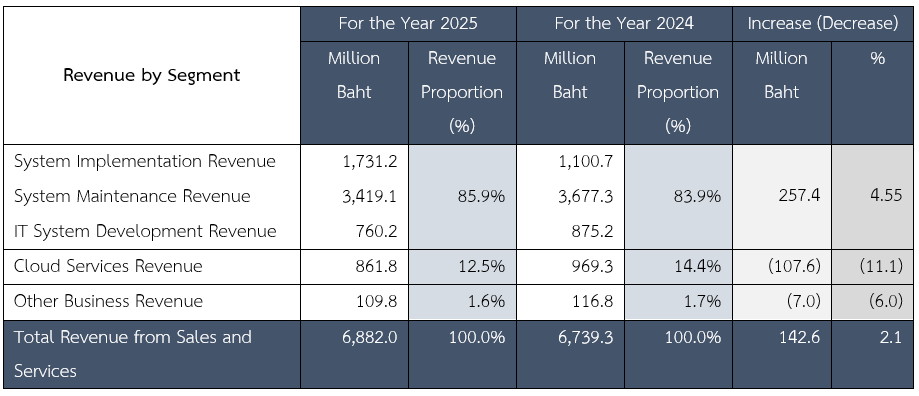
The Group generates revenue from three core business segments: system implementation, system maintenance, and IT system development services. In 2025, these three core segments accounted for 85.9% of total revenue from sales and services (2024: 83.9%). Revenue from these core business segments increased by THB 257.4 million, representing a 4.6% growth compared with the previous year.
In 2025, the improvement in operating performance was primarily driven by System Integration (SI) revenue. The Company secured several medium- to large-scale projects during the year and was able to progressively recognize revenue in line with project delivery schedules. As a result, revenue from this segment increased significantly compared with the previous year. Projects recognized in the current year also generated higher gross profit margins than those in the previous year. Consequently, gross profit from system implementation increased in proportion to revenue growth, becoming a key factor contributing to the overall improvement in the Company’s gross profit margin for the year.
For Maintenance Agreement (MA) services, although revenue slightly decreased compared with the previous year, the Company was able to manage costs and MA contract renewals efficiently. As a result, the gross profit margin of the MA segment improved significantly year-on-year, reflecting improvements in service quality and operational efficiency. MA services remain one of the Company’s core businesses, generating recurring revenue recognized throughout the contract period. The Company provides maintenance services across multiple systems for organizations in both the public and private sectors, contributing to stable recurring income and strengthening the sustainability of the Company’s overall revenue structure.
For cloud services, although revenue declined compared with the previous year, this segment generally operates at lower profit margins compared with the Company’s core businesses. Therefore, the 11% decline in cloud service revenue did not have a significant impact on the Company’s overall profitability.
Other Income
For 2024 and 2025, the Company recorded gains from other activities, with the following significant items:
For 2024
A gain on disposal of investment in a subsidiary amounting to THB 42.1 million was recognized from the sale of the Company’s investment in Playtorium Solutions. The investment was sold for THB 69.3 million, and the transaction was completed on 30 September 2024, resulting in Playtorium Solutions ceasing to be a subsidiary on the same date.
For 2025
A gain on disposal of investment in an associate amounting to THB 3.3 million was recognized from the sale of the Company’s investment in Promptnow. The transaction was completed in the first quarter of 2025.
Costs and Expenses
Cost of Sales and Services
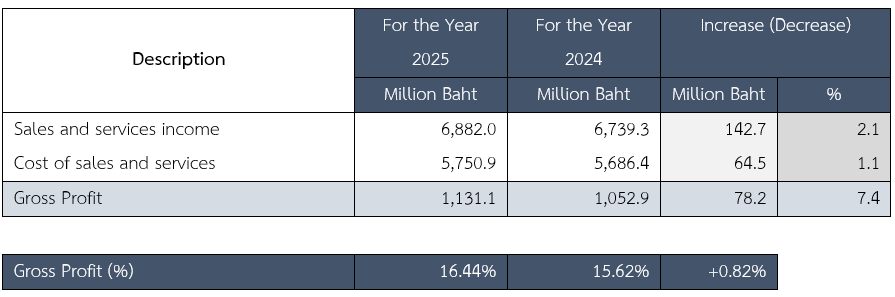
Cost of sales and services for 2025 amounted to THB 5,750.9 million. The Group recorded an overall gross profit margin of 16.44%, representing an improvement from the previous year. This reflects enhanced cost management efficiency and improved project execution quality, particularly the significant increase in gross profit from Maintenance Agreement (MA) contracts. This improvement resulted from effective project cost control and service cost management, along with efficient project planning and timely delivery, which helped reduce the risk of cost overruns and unnecessary expenses.
At the same time, the Company’s fixed cost structure, particularly personnel expenses related to project management and delivery, was able to support the higher revenue level without requiring proportional cost increases. This supported stronger operational performance and enabled projects to generate higher gross margins overall. The increase in gross profit this year reflects the Company’s ability to secure better margins from medium- to large-scale projects, while maintaining effective cost control.
Selling and Administrative expenses
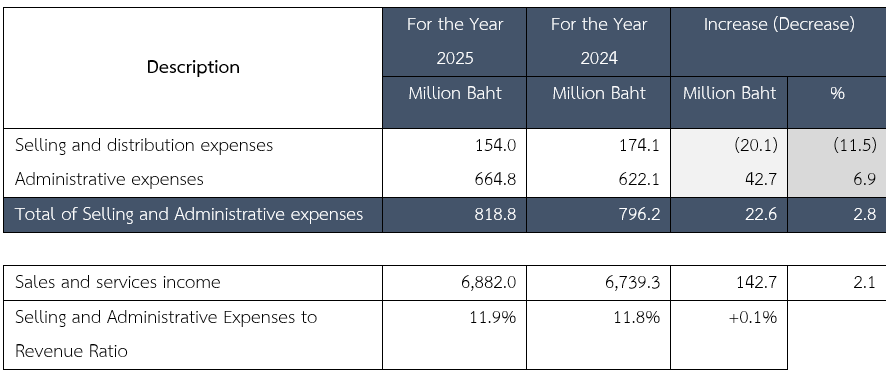
For 2025, the Group recorded selling and administrative expenses totaling THB 818.8 million, representing a slight increase of 2.8% compared with the previous year, in line with revenue growth. The selling and administrative expenses to revenue ratio was 11.9%, which is consistent with the previous year. The Group maintained effective cost control by managing expenses at an appropriate level and striving to maximize efficiency in its spending. Administrative expenses for the current year include special items related to the accounting revaluation of investments and goodwill, which are non-recurring items and not related to the Company’s core operations. These items do not impact the Company’s operating cash flow.
Share of profit from investments in associates

The share of loss from investments in associates and joint ventures for 2025 amounted to THB 16.5 million (2024: share of profit of THB 16.3 million), representing an increase of THB 0.2 million, or 1.2%, compared with the previous year. This change was primarily due to an increase in the share of losses from investments in Angstrom Solutions and Data Cafe, which were affected by technological changes in the industry.
Finance cost
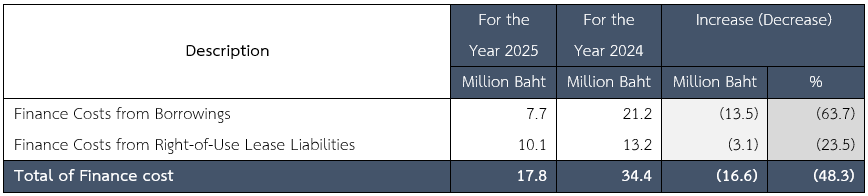
Total finance costs of the Group for 2025 amounted to THB 17.8 million, decreasing by THB 16.6 million, or 48.3%, compared with the previous year. The decline was primarily driven by a reduction in interest expenses from borrowings, which decreased by THB 13.5 million, or 63.7%, compared with the previous year. This reflects the Company’s improved financial liquidity, supported by effective management of cash flows from operations, allowing the Company to significantly reduce its reliance on short-term borrowings from financial institutions. Meanwhile, finance costs from right-of-use lease liabilities decreased by THB 3.1 million, or 23.5%, as the Company gradually settled its lease obligations during the year, resulting in a corresponding reduction in lease-related interest expenses.
The reduction in finance costs in 2025 reflects the Group’s ability to efficiently manage liquidity and optimize its capital structure, strengthening its financial position and supporting sustainable business operations in the long term. The Company continues to maintain prudent liquidity management while focusing on effective and flexible financial structure management to adapt to volatility in the financial and capital markets, and to maintain finance costs at an appropriate level for future business operations.
Net Profit
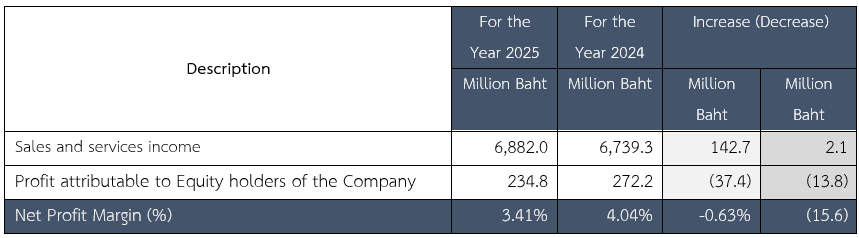
For 2025, the Group reported net profit attributable to the Company’s shareholders of THB 234.8 million, a decrease of THB 37.4 million, or 13.8%, compared with the previous year. This occurred despite revenue from sales and services increasing by THB 142.7 million, or 2.1%, year-on-year. The decline in net profit was primarily due to the recognition of a one-time gain of THB 42.1 million from the disposal of investment in a subsidiary in 2024, which did not recur in 2025. As a result, total net profit in the current year decreased when compared with the previous year. However, when considering profit from normal operations, the Company was able to maintain performance and achieve growth compared with the previous year. This was supported by higher gross profit margins from the delivery of several medium- to large-scale IT system integration projects, along with effective cost and operating expense management.
The Net Profit Margin for 2025 was 3.41%, decreasing from 4.04% in 2024, mainly due to the one-time gain recognized in 2024 from the disposal of the subsidiary investment. Overall, the Company continued to maintain its profitability from core business operations, despite ongoing economic challenges. The Company remains focused on delivering high-quality technology products and solutions while maintaining high service standards to support the continued expansion of demand across various industries.
At the end of 2025, the Group maintained a portfolio of ongoing projects with longer average project durations, including long-term service contracts and system maintenance agreements. These contracts create opportunities for the Company to generate recurring income in future accounting periods throughout the duration of the contracts and projects. Maintaining a stable base of recurring revenue plays a crucial role in supporting the long-term stability of the Group’s revenue and financial performance.
Liquidity & Capital Adequacy
Cash Flows
For 2025, the Group generated cash flows from operating activities of THB 993 million, representing a significant increase compared with the previous year. This reflects the Group’s effective operating cash flow management, particularly from project deliveries and timely customer collections, which significantly improved the Company’s liquidity position. In addition to operating cash flows, the Company also received additional funding from interest income, dividend income, and the disposal of investments in mutual funds, totaling approximately THB 135 million. As a result, the total Source of Funds in 2025 amounted to THB 712 million.
In terms of Use of Funds, the majority of cash was used for the repayment of short-term borrowings from financial institutions totaling THB 225 million, dividend payments of THB 221 million, and income tax payments of THB 166 million. The Company also made additional investments in associates amounting to THB 87 million, as well as investments in property, plant and equipment and intangible assets to support future business operations.
As a result of these cash flow management activities, the Group’s cash and cash equivalents increased by a net amount of THB 416 million as of the end of 2025, reflecting a stronger financial liquidity position compared with the previous year.
Capital Adequacy
As of 31 December 2025, the Group reported a Current Ratio of 1.40 times, increasing from 1.38 times in 2024, reflecting improved financial liquidity driven by higher cash flows from operating activities and the reduction of short-term borrowings from financial institutions. The Company’s ability to generate strong operating cash flows provides sufficient liquidity to support business operations, investments in new projects, and the effective repayment of financial obligations. In addition, the Group maintains available credit facilities from financial institutions totaling more than THB 2,700 million, as well as a credit facility from its major shareholder, TIS Inc., with a total borrowing limit of JPY 3,800 million (approximately THB 785 million). These facilities are intended to support the Group’s business operations and future investment projects.
With strong financial liquidity from operating cash flows, together with access to additional funding sources from financial institutions and the major shareholder, the Group is well-positioned with adequate capital to support future business expansion and undertake large-scale projects effectively in the long term.
Asset Management Capability
Statement of financial position
Assets
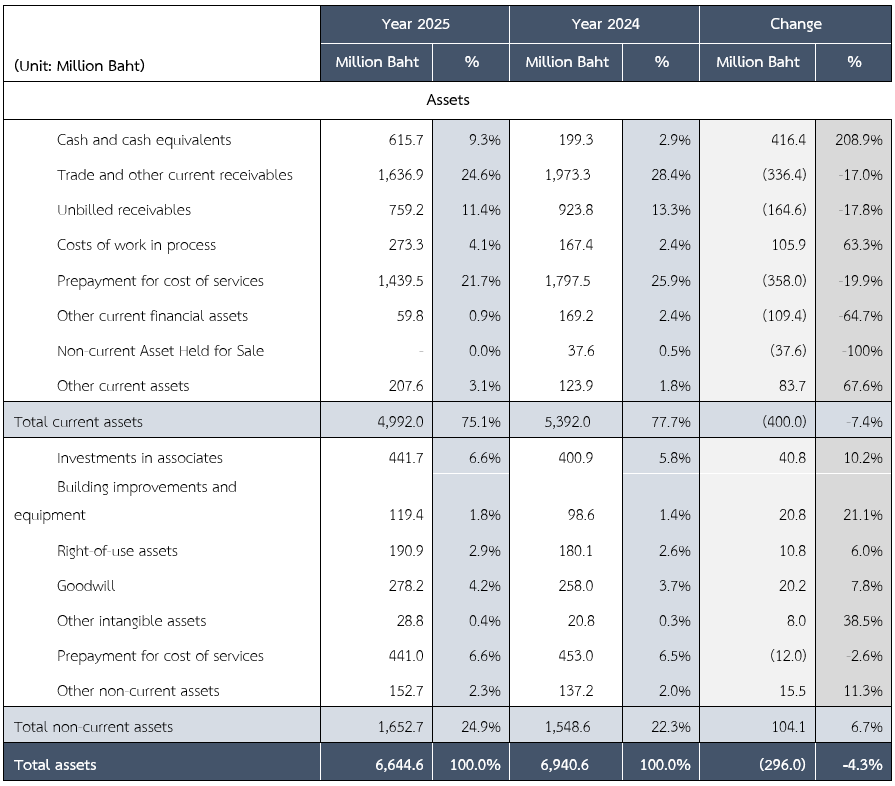
As of 31 December 2025, the Company reported total assets of THB 6,644.6 million, representing a decrease of THB 296.0 million, or 4.3%, compared with the previous year. The key factors are summarized as follows:
Cash and cash equivalents increased by THB 416.4 million, mainly due to a significant increase in cash flows from operating activities, driven by project deliveries and customer payments—particularly during the fourth quarter of the year. This reflects the Group’s effective liquidity management. The stronger operating cash flow and improved liquidity also enabled the Group to reduce finance costs by THB 16.6 million, or 48%, which directly contributed to higher net profit.
Trade and other receivables decreased by THB 336.4 million, consistent with the increase in operating cash flow. This resulted from efficient receivables management and collection efforts, particularly the receipt of payments for invoiced project deliveries toward the end of 2025.
Unbilled revenue decreased by THB 164.6 million, reflecting efficient project delivery and billing processes. The reduction in unbilled revenue also contributed to the improvement in the Group’s financial liquidity during the year.
Prepayment for cost of services (including non-current portions) decreased by THB 370 million, mainly due to the progressive recognition of service costs under maintenance service contracts during the year, particularly costs related to maintenance services.
Investments in joint ventures and associates increased by THB 40.8 million, resulting from an investment made through Synergy Group Ventures, which acquired a 35% stake in Cleverse Corporation, a company specializing in AI transformation development and services. The investment totaled THB 85 million, and the Group made this investment in December 2025.
Liabilities
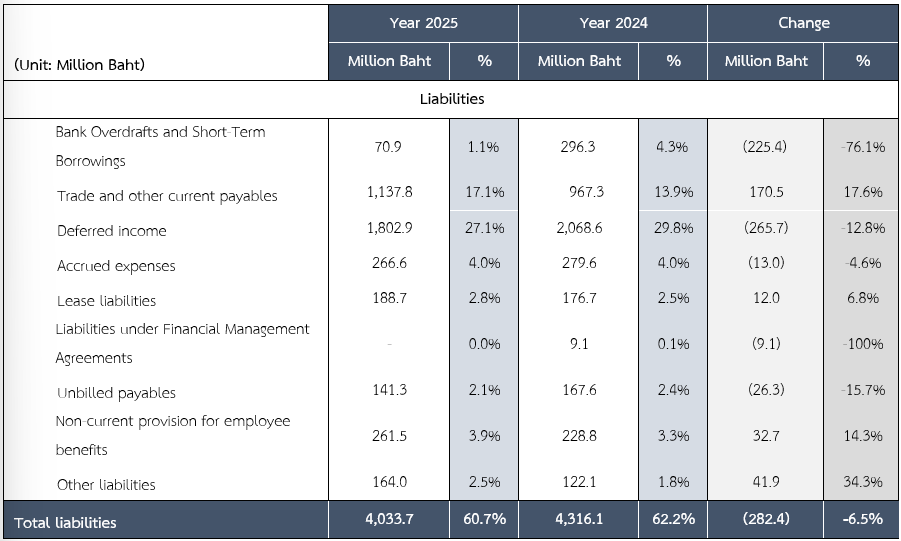
As of 31 December 2025, the Company reported total liabilities of THB 4,033.7 million, representing a decrease of THB 282.4 million, or 6.5%, compared with the previous year. The key factors are summarized as follows:
Short-term borrowings from financial institutions decreased by THB 225.4 million, primarily due to improved operating liquidity of the Group. Cash flows from operating activities for 2025 amounted to THB 950 million, representing an increase of approximately 1.7 times compared with the previous year.
Trade and other payables increased, mainly from outstanding balances that had not yet reached their credit terms at year-end. Some of the outstanding amounts were settled close to the end of the year, while the increase was also partly attributable to higher accrued expenses recorded at year-end compared with the previous year.
Deferred income decreased, in line with the reduction in prepaid service costs, reflecting the recognition of revenue and related costs from maintenance service projects during the current year.
Shareholders' equity
The changes in shareholders’ equity for the years 2025 and 2024 are summarized as follows:
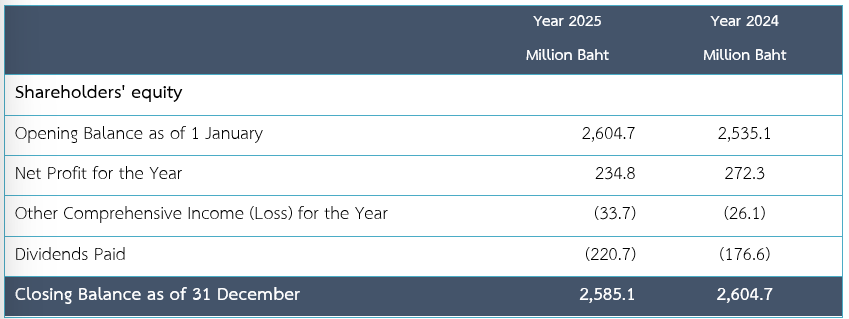
As of 31 December 2025, the Company reported total equity attributable to the owners of the Company of THB 2,585.1 million, representing a decrease of THB 19.6 million compared with the previous year. This change was mainly attributable to the net profit for 2025 of THB 234.8 million, offset by dividend payments declared and paid during the year totaling THB 220.7 million, and the recognition of other comprehensive loss for the year amounting to THB 33.7 million.
Liquidity Ratios
For 2025, the Group reported a Current Ratio of 1.40 times, increasing from 1.38 times in 2024. The Quick Ratio was 0.64 times, compared with 0.59 times in the previous year, while the Cash Ratio improved significantly to 0.25 times, up from 0.13 times in 2024.
The improvement in liquidity reflects the Group’s effective management of operating cash flows, particularly from project deliveries and customer collections toward the end of the year, which resulted in a significant increase in cash and cash equivalents. As a result, the Company maintained strong financial liquidity and sufficient capacity to support its business operations.
Asset Turnover Ratios
The Group’s asset turnover ratios improved significantly compared with the previous year. Inventory turnover increased, resulting in a shorter average inventory holding period. This improvement was mainly driven by the higher number of newly awarded projects that were completed and delivered during the fourth quarter of the year, leading to a shorter average project execution period and an overall improvement in asset utilization. In 2025, the Group reported an Asset Turnover ratio of 1.02 times, up from 0.96 times in 2024, reflecting improved efficiency in utilizing assets to generate revenue.
The trade receivables turnover ratio increased to 4.51 times, compared with 3.88 times in the previous year, resulting in a reduction in the average collection period to 80.91 days, from 93.97 days in 2024. This reflects a significant improvement in receivables management and collection efficiency. At the same time, the inventory turnover ratio increased to 3.13 times, from 2.67 times, resulting in a shorter average inventory period of 116.71 days, compared with 136.80 days in the previous year.
In terms of trade payables, the Group recorded a payables turnover ratio of 5.46 times, increasing from 5.01 times, which resulted in a reduction in the average payment period to 66.80 days, from 72.92 days in the previous year.
As a result of these factors, the Company’s Cash Cycle decreased to 130.82 days, compared with 157.85 days in 2024, reflecting an improvement in working capital management and overall cash flow management. In addition, the Group reported cash flows from operating activities of THB 993 million in 2025, representing a significant increase of THB 441 million from the previous year.
Capital Structure Ratios
As of 31 December 2025, the Group reported a debt-to-equity ratio of 1.54:1 (2024: 1.64:1). The decrease in the debt-to-equity ratio reflects an improvement in the capital structure, primarily due to the reduction in short-term borrowings from financial institutions, as the Company generated significantly higher cash flows from operating activities. In addition, the Group’s Interest-Bearing Debt to EBITDA ratio decreased significantly to 0.17 times, compared with 0.69 times in 2024, indicating a substantial reduction in debt burden.
Meanwhile, the Interest Coverage Ratio improved to 23.27 times, from 12.97 times in the previous year, reflecting the Group’s stronger ability to service interest obligations, supported by both lower finance costs and increased operating cash flows.
Overall, the Group continues to maintain a solid capital structure, with effective management of liquidity and debt obligations despite the continued volatility in the financial and capital markets
Profitability and Return on Investment
For 2025, the Group reported a Gross Profit Margin of 16.44%, increasing from 15.62% in 2024, reflecting an improvement in revenue quality and more effective project cost management. This improvement was mainly driven by the recognition of revenue from medium- to large-scale System Integration (SI) projects, which typically generate higher margins. The Group remains committed to maintaining profitability by controlling operating costs appropriately and maximizing the efficient use of resources, while continuing to uphold service quality amid ongoing price competition in the industry, which continues to exert pressure on operating costs and gross margins.
However, the Operating Margin decreased to 4.98%, compared with 5.55% in the previous year, while the Net Profit Margin was 3.41%, down from 4.04% in 2024. The decline was mainly attributable to the higher profit base in 2024, which included a one-time gain from the disposal of an investment in a subsidiary.
In terms of shareholder returns, the Return on Equity (ROE) for 2025 was 8.99%, decreasing from 10.37% in 2024, while the Return on Assets (ROA) was 3.46%, slightly lower than 3.80% in the previous year. Despite the slight decline in ROA and ROE, the Group continues to maintain stable profitability from its core business operations amid an increasingly competitive industry environment.
The Dividend Payout Ratio for 2025 was 94.01%, increasing from 64.86% in 2024, reflecting the Company’s capital management policy aimed at delivering appropriate returns to shareholders while maintaining long-term financial stability. (Please refer to the section on dividend payments for further details.)
Debt Obligations & Off-Balance-Sheet Management
Debt Servicing Capacity Ratios
As of 31 December 2025, the Group reported an Interest-Bearing Debt to EBITDA Ratio of 0.17 times, a significant decrease from 0.69 times in 2024. This reflects the reduction in interest-bearing debt, primarily resulting from the repayment of short-term borrowings and the increase in cash flows from operating activities.
At the same time, the Group’s Interest Coverage Ratio was 23 times, increasing from approximately 13 times in 2024. This indicates the Group’s strong ability to generate EBITDA from its core business operations, which is more than sufficient to cover its interest obligations.
Overall, the Group continues to maintain a solid financial position, while prudently managing its capital structure and debt obligations to withstand potential volatility in economic and financial market conditions, and to support sustainable business growth in the long term.
Material & Related-Party Transactions
In 2025, the Company entered into one significant connected transaction, which was disclosed in accordance with the corporate governance and disclosure requirements of the Stock Exchange of Thailand (SET). The transaction involved financial assistance from TIS Inc., the Company’s major shareholder holding 48.99% of the Company’s shares, and is therefore considered a connected transaction. The financial assistance was provided in the form of a loan facility totaling JPY 3,200 million, equivalent to approximately THB 722.6 million. The value of this connected transaction represented 0.784% of the Company’s Net Tangible Assets (NTA). The Company disclosed this transaction through the SET disclosure system on 16 December 2024, in compliance with the relevant regulatory requirements.
Debt Securities with Financial Ratio Requirements
Debt Securities with Financial Ratio Requirements Issued?
No
Factors That May Affect Financial Condition
Factors or Incidents That May Materially Affect Financial Condition
The Group operates as a comprehensive IT service provider, delivering solutions to enterprise clients across the private sector, state enterprises, and government agencies. The Company recognizes the importance of both external and internal factors that may impact its financial position and operating performance in both the short and long term. As such, the Company places strong emphasis on risk management to ensure stable business operations and to strengthen its ability to achieve sustainable growth, amid rapidly evolving economic, technological, and regulatory environments.
To address these challenges, the Company has established a comprehensive policy framework focusing on managing technological change, customer relationship management, human resource development, and financial risk management. The Company also emphasizes diversifying its customer base and industry coverage in order to reduce reliance on any single market or industry. In addition, the Company continues to invest effectively in technology and innovation to enhance its long-term competitive capabilities.
The Group also prioritizes strategic risk management, with continuous monitoring and assessment of risk factors that may affect its business operations. This enables the Company to adjust its business strategies in line with the rapidly evolving information technology industry. Furthermore, the Company places importance on financial liquidity management, implementing cost control strategies alongside the development of recurring revenue streams, particularly from long-term service contracts and maintenance agreements, which help strengthen the stability of its long-term revenue structure.
The Company is committed to building a sustainable organization by promoting business practices that take into account Environmental, Social, and Governance (ESG) factors, enhancing employee capabilities, and operating under transparent corporate governance principles in order to build trust among shareholders and all stakeholders.
The factors that may affect the Company’s financial position or operating performance in the future can be summarized as follows:
Economic and Political
Global and Domestic Economic Conditions: Economic slowdown, inflation, or persistently high interest rates may affect customers’ investment decisions in information technology.
Political Stability and Regulatory Environment: Changes in government policies related to digital technology adoption and cybersecurity may influence the investment direction of both the public and private sectors.
IT Industry and Technological Changes
Rapid Technological Advancements: Developments in technologies such as Artificial Intelligence (AI), Cloud Computing, and Cybersecurity may require the Company to invest further in infrastructure and the development of specialized workforce skills.
Increasing Industry Competition: The entry of new IT service providers, including international firms operating in Thailand, may intensify competition within the market.
Customer and Market Demand
Changes in Enterprise Customer Behavior: Customers may adjust their IT budgets or change their procurement models for technology services.
Management of Large-Scale Contracts and Projects: Delays in project execution may affect the Company’s revenue recognition and cash flow.
Cost and Human Resource
Personnel and Employee Benefit Costs: The cost of skilled technology professionals may increase in line with the competitive labor market.
Employee Turnover Rate: Higher turnover may affect operational efficiency and the continuity of service delivery.
Cybersecurity and Regulatory Compliance
Cybersecurity Risks: Cyber threats may impact the Company’s IT systems as well as those of its customers.
Compliance with Laws and Data Security Standards: Regulations such as the Personal Data Protection Act (PDPA) or standards ISO 27001 may increase operational costs due to compliance requirements.
Financial and Cash Flow Risks
Foreign Exchange Fluctuations: As the Company procures software and services from overseas suppliers in significant proportions, exchange rate volatility may directly affect the cost of sales and services.
Liquidity and Cash Flow Management: Delays in customer payments may affect the Company’s working capital management and overall cash flow stability.
Environmental, Social, and Governance (ESG)
Sustainability and Environmental Policies: Increasing demand for Green IT solutions and corporate initiatives to reduce carbon footprints may require the Company to adapt and enhance its service offerings to align with customers’ sustainability goals.
Technology Partners and Vendors
Changes in Business Policies: Adjustments in pricing structures or service models by global technology providers may affect the Company’s service delivery models and revenue structure.
Shift in Software Distribution Models: The transition from traditional software licensing to subscription-based or cloud-based services may influence the Company’s revenue recognition and business model.
Project Execution Risk
Large-Scale IT Projects: Certain system integration and technology implementation projects involve significant value and long execution periods. Delays or scope changes may impact the Company’s revenue recognition, project costs, and cash flows.
Resource Allocation: The ability to allocate skilled personnel appropriately across projects is essential for maintaining operational efficiency and project profitability.
Artificial Intelligence (AI) Disruption Risk
Rapid Advancement of AI Technologies: The rapid evolution of Artificial Intelligence (AI) may significantly change how IT systems are developed and delivered. If the Company is unable to adapt to these technological trends, it may affect its long-term competitiveness.
Emergence of New Competitors: The adoption of AI in enterprise systems may introduce new forms of competition from emerging technology providers and global platform companies continuously developing AI-driven solutions.
Growing Demand for AI and Data Engineering Talent: The increasing need for professionals with AI and Data Engineering expertise may intensify competition for talent and potentially increase operating costs.
In response, the Group places strong emphasis on developing its capabilities in AI and data technologies through continuous employee skill development, collaboration with technology partners, and the development of new solutions, enabling the Company to adapt effectively to future changes in the information technology industry.